
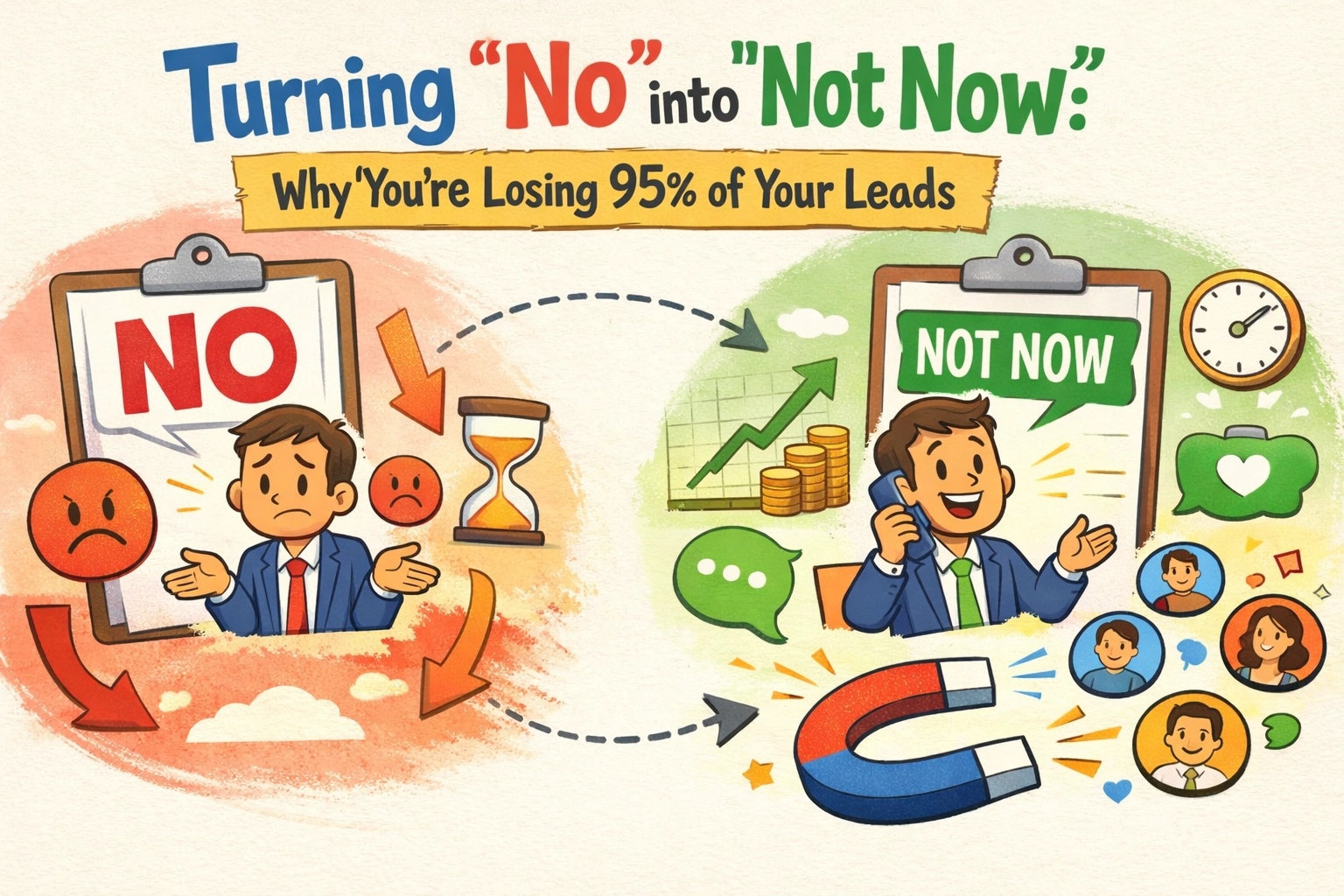
Let’s be real for a second. Most mortgage professionals are running their business like a game of “hot potato.”
If a lead comes in and they aren’t ready to sign a 1003 today, they get tossed in the trash. You might not literally put them in the garbage can, but you do something just as bad: you tell them to “call me when your credit is better.”
In your head, you think you’re being helpful. In reality, you’re handing your commission check to a billionaire tech company.
The truth is, 95% of the people who interact with your brand today aren’t ready to buy a house this afternoon. They have “stuff” in the way. Credit issues, a lease that isn’t up, or a pile of credit card debt.
If you only focus on the 5% who are “ready right now,” you are fighting for scraps with every other loan officer in town. The real money, the real leverage, is in the 95%.
It’s time to stop turning “No” into “Goodbye” and start turning it into “Not Now.”
The Two Types of Loan Officers
In this business, I see two very different types of loan officers. One is struggling to find their next deal, and the other is building an empire.
Type #1 – The “Call Me Later” Loan Officer
This is the most common LO out there. They are “busy,” but they aren’t productive. When a lead comes across their desk with a 580 credit score, they shut down.
They say things like:
- “Your credit needs to improve before we can do anything.”
- “Go pay some things down and call me back.”
- “Come back and see me in six months when you’ve saved more money.”
Then, the client disappears.
There is no plan. There is no system. There is zero follow-up.

Type #2 – The “Let’s Fix It Together” Loan Officer
This loan officer understands blue-collar psychology. They know that if someone reaches out, they want to buy a house, even if they can’t right now.
Instead of turning the client away, they become a guide. They say:
“Don’t worry about the score right now. Let’s make a plan to get you where you need to be.”
They don’t just give advice; they give the client a tool. They enroll the lead in something like the FinToolbox (powered by Finlocker). Now, the relationship isn’t over; it’s just beginning.
The Silent Killer: Why “Call Me Later” is Losing You Money
When you tell a client to go fix their credit on their own, what do they actually do?
They don’t sit in a dark room and study the Fair Credit Reporting Act. They go to the App Store. They download Credit Karma, Experian, or Rocket Money.
Now, guess who is talking to your client every single week? It’s not you.
It’s a multi-billion dollar marketing machine. Those apps send push notifications. They send emails. They offer “pre-approved” credit cards and personal loans. And eventually, when that credit score hits 640, they are going to offer them a mortgage.
The client will take it. Why? Because that app helped them for six months while you were nowhere to be found.
You didn’t just lose a lead. You gave a lead to your biggest competitor. We need to do better. Hope isn’t a strategy, and “call me later” is a recipe for a flat bank account.

The Math of the 95%
Most mortgage broker lead generation strategies for 2026 focus on finding the “perfect” lead. But the math doesn’t work that way.
Research shows that only about 5% of leads are ready to buy the moment they contact a business. That leaves 95% in the “thinking about it” or “not quite ready” stage.
Think about your own numbers. How many of your leads actually convert?
- 1 out of 20?
- 1 out of 10?
- Maybe 1 out of 5 if you’re a total rockstar?
That means 80% to 95% of the people you talk to are future clients. They aren’t “bad leads.” They are just “later leads.”
If you aren’t staying connected to that 95%, you are essentially burning money in the backyard. The real game isn’t “How do I close this lead today?” The real game is “How do I stay the only choice in their mind until they are ready?”
Using Systems to Gain Leverage
If you want to grow, you need systems for mortgage brokers to gain leverage. You can’t manually call 500 “not ready” leads every week. You’ll burn out in a month.
This is where the “Type #2” loan officer wins. By using a tool like FinToolbox, you automate the value.
When you enroll a client in a financial fitness app, a few powerful things happen:
- The client gets alerts: They see their score move. They get excited.
- They get tools: They see exactly what they need to do to improve.
- You are the guide: Your face and name are attached to their progress.
Instead of disappearing, you are in their inbox and on their phone with stuff they can actually use. Most LOs send a generic newsletter about “how to spruce up your garden in the spring.” Let’s be honest, nobody cares about your garden tips. They care about their credit score and their ability to buy a home.

Tactical Win: Saving Money on Credit Pulls
Let’s talk about the “white-collar sales” side of this for a second. We all know that credit reports aren’t getting any cheaper. Pulling credit on every “maybe” lead can eat into your margins fast.
Here is a pro tip: When you use a system like FinToolbox, the client can often share their credit data with you directly through the app.
This gives you the visibility you need to help them without you having to pay for a soft pull or a hard pull immediately. It saves you money, and it saves the client a hit to their score. $$$ matters to everyone. Being the LO who saves the client money before the deal even starts is a massive way to increase value added to real estate clients.
What This Looks Like in Real Life (The Email You Want)
I’d like to include a place for them to see it.
But let me clarify something:
This isn’t a “nice email a client decided to send me.”
This is an automated notification from FinLocker that I (the loan officer) get any time a client’s credit score moves by 10 points.
That email is the trigger. It tells me exactly when to call.
Now picture getting those alerts from people you talked to 3–5 years ago… the ones who “weren’t ready right now.”
Now let me point the finger a little…
How much money have you left on the table over your entire career because you weren’t getting these emails?
Because every time a client’s score jumps 10 points and you don’t know, one of two things happens:
- They keep getting marketed to by big tech (Credit Karma, Experian, Rocket, you name it)
- They get “help” from whoever showed up last and stayed in their face
And when they finally hit that magic number?
Somebody else gets the deal.
Not because they’re better than you.
Because they had a system watching the lead… and you didn’t.
That’s thousands (sometimes tens of thousands) in commissions you basically handed over… just because you weren’t getting the signal at the right moment.
What if you received these types of emails on the regular from clients you’ve spoken with over the last three to five years that weren’t ready right now? bet you wouldn’t do less business.
That’s the whole point of turning “No” into “Not Now.”
You don’t need more leads. You need a better plan for the ones you already had.
The Real Question
So, here is the real question for you today: Do you have a plan for the people who aren’t ready right now?
If your strategy is to just “follow up in a few months,” you’ve already lost. You need a system that stays in front of them with high-value data. You need to be the one they think of when their score finally hits that magic number.
Stop being the “Call Me Later” guy. Start being the guide.
Your Action Plan for This Week:
- Stop the Bleeding: Look at every lead from the last 90 days that didn’t go to contract.
- Audit Your Messaging: Are you telling people “no,” or are you telling them “not now, here is the plan”?
- Get a System: Find a tool like FinToolbox or Finlocker that allows you to provide ongoing value without manual labor.
- Send the Invite: Reach out to those old leads and offer them a free financial fitness tool to help them get home-ready.
The loan officers who win in 2026 aren’t just the ones who are good at closing. They are the ones who are great at guiding.
Let’s fix it fast. Let’s do better.
[PICTURE_PLACEHOLDER: John Jurkovich Headshot]
